Linked Zero Sync 
ai & security; research and policy @ big corp. pnw 🏔️🌲
-
Falsification Engine: After finding a potential vulnerability, VulnHunter runs a structured reasoning workflow specifically designed to disprove its own argument. It searches for flawed assumptions, logic gaps, or security controls that would block the attack.
-
Evidence-Backed Remediation: When a defect survives the falsification engine, VulnHunter maps the exact exploit path and generates focused, targeted code changes for review.
-
Attacker-First Forward Analysis: VulnHunter flips the "sink-first" security model to reduce false positives by simulating a bad actor's exact journey. It begins at potential attacker-accessible entry points (APIs, network messages, file uploads) and reasons forward to evaluate whether an attacker can truly break through.
Heider and Simmel (1944) animation
Solid US-origin open model, congratulations Thinking Machines
- context window of 1M
- available on hugging face now
- between opus 4.6 and gpt 5.6 on a web dev benchmark
- token efficient
- 41B active params of 975B total
https://www.wired.com/story/thinking-machines-lab-releases-its-first-model-inkling/
I don't know how many ways to say this but
- stop looking at model performance
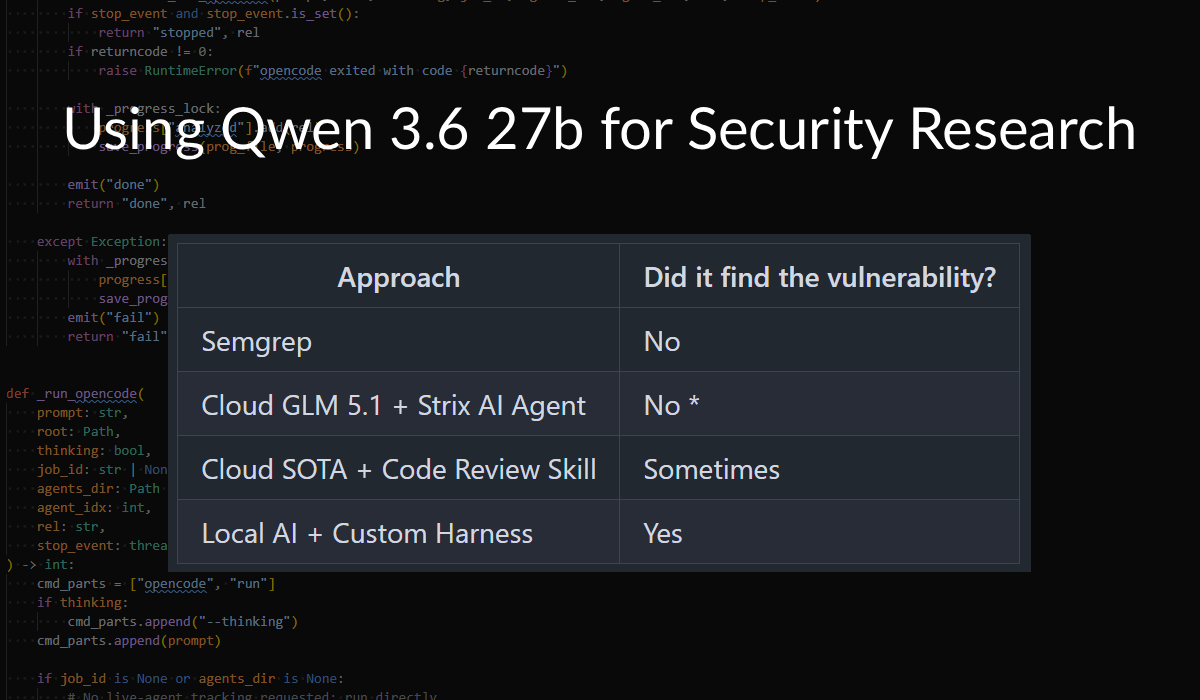
- it's almost all in the harness
- decent harness can easily outclass top model
evidence item #71625: https://developer.nvidia.com/blog/create-a-langchain-deep-agents-harness-profile-for-nvidia-nemotron-3-ultra-to-improve-performance/
I want to jump on a couple of false dichotomies around LLM speak:
- "frontier" models vs. open model - leading models can be open
- closed model vs. Chinese model - where the model's made has no impact on how it's distributed
You can have open frontier models, closed Chinese models, open US models, closed non-frontier models (private models make sense!)
Anonymised analysis of the openai model 'breaching' hugging face:
report doesn't say what sandbox sol broke out of??
a docker container running as root
Plot twist there was no sandbox at all
many use "sandbox" and "container with host access" interchangeably
ymmv, use critical thinking
There are two readings here:
- optimising efficiency means reduced costs (fiscal & environmental)
- optimising efficiency means increased consumption (jevon's paradox)
And a very cynical third one:
- Money not spent on infra is money that can be billed for compute facilities
I think both are valid. But either way, doing the same for less is for some reason attractive to me.